Master's Thesis · Interaction Design — 2026
- My roles
- Design Researcher · Interaction Designer · UI Designer · Frontend Developer · Editorial Designer
- Client
- Politecnico di Milano
- Location
- Milan, Italy
A conversational AI companion that helps people with mild cognitive impairment recover personal context, while they decide what it remembers and can check where each detail came from.
The question
Mild cognitive impairment (MCI) can make personal information harder to reach while leaving many everyday abilities intact. A forgotten name, conversation or plan can affect practical activity, confidence and a person's sense of continuity.
My master's thesis asks one question: how can a conversation-led digital companion help people with MCI recover that context, while they keep control over what it retains, how it interprets it and when it brings it up again?
The problem
The research starts from the literature on living with MCI: 49 candidate needs, consolidated into 24 and grouped into six clusters, from trust and privacy to autonomy and identity. I then analysed twelve existing products against them: AI companions, social robots, and memory tools such as Obsidian and NotebookLM.
The same gap kept appearing. Existing tools tend either to hide their memory or to make the person maintain it: the first cannot be questioned, the second has to be kept in order.
The approach
I separated authority from maintenance. The person decides whether something is kept, used or shared; the system does the organising and shows where its interpretations come from. Ordinary phrases stand in for managing an archive: “That isn't Anna”, “Don't mention this again”, “Show me where this came from”.
Three rules follow from this. The clips below show each one in the working prototype.
It asks before it keeps anything
A detail mentioned in conversation is only a candidate. The companion repeats the exact statement and asks; it is stored only after a yes, and the screen says plainly when nothing has been saved.
Every answer shows its source
When a reply draws on something stored, the person's original words appear beneath it, with the day they said them. They can judge whether it fits instead of taking the companion's word for it.
A correction changes the record
Saying that something is wrong is enough. The companion proposes the corrected statement, waits for a yes, and keeps the earlier version as history, so a correction changes how context is used without rewriting what the person said.
Recorded in the working prototype, with fictional data. The person names the companion at first run: Luma here, Juno in the figures.
The interface
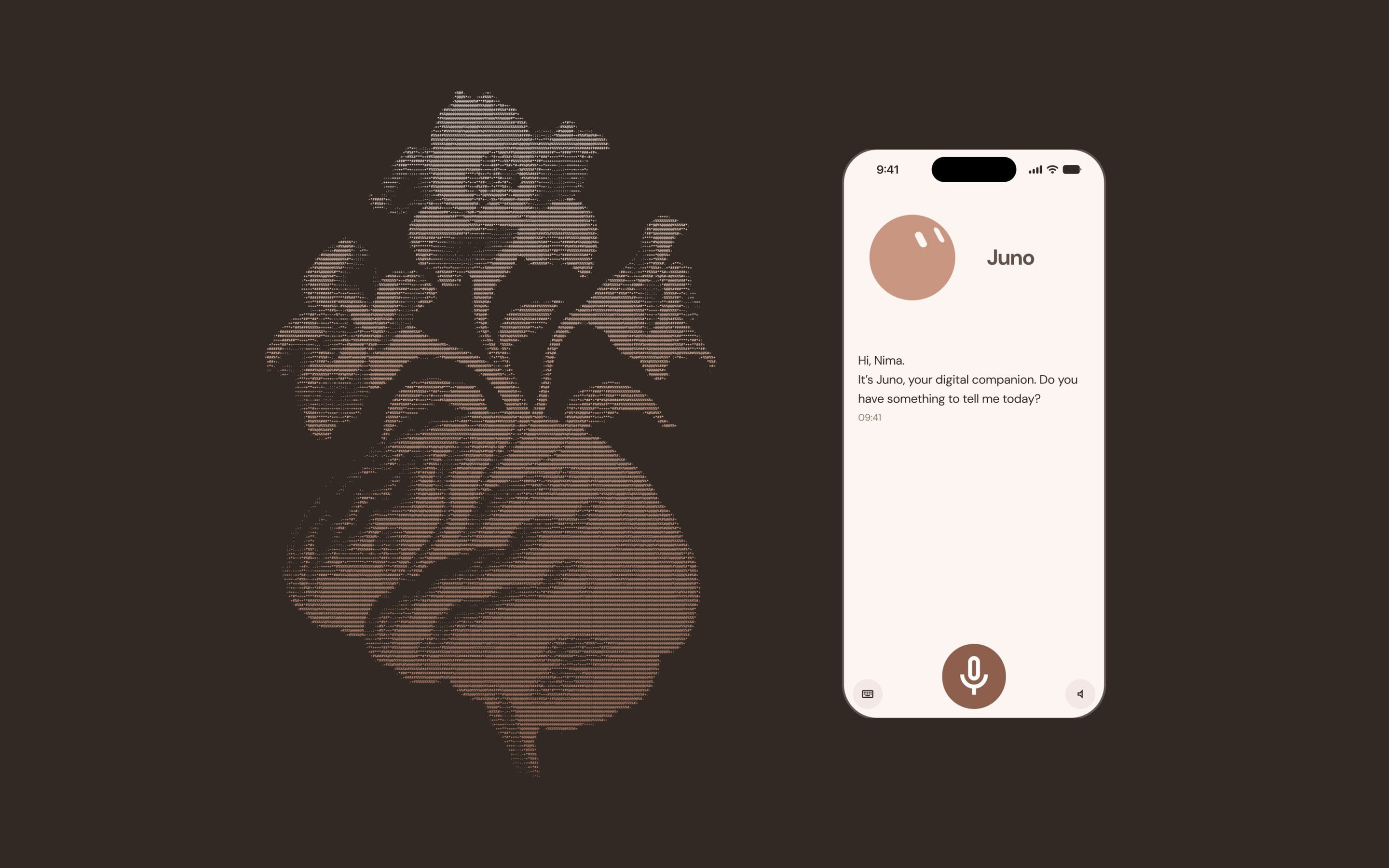
In Figma I designed a quiet interface for short, unhurried conversations: a warm pale canvas, white reading surfaces, brown text and DM Sans. What the companion says stays on screen, so the person can re-read it, open a source, correct it or stop.
The round character is a placeholder borrowed from an open-source project, not my design; a real service would need its own.
The prototype
I built it as a working web app in Next.js. Voice runs in real time through the OpenAI Realtime API over WebRTC, and typing is a full alternative in the same conversation, for anyone who cannot or would rather not speak.
Memories are stored in a Neo4j graph, and only after the person agrees to a specific statement. Four of the five service scenarios are implemented, fully or in part.
A trusted person, who can only ask
A separate review canvas lets an invited person explore what the companion remembers and raise a question about an interpretation. They cannot correct, hide or delete anything: those controls stay with the person whose memories they are, and a question is never treated as evidence.
A convincing reply is not proof
Testing the prototype by voice, I found ten problems, and six of them would not have shown up in a transcript. I hid a claim about Maria and then asked the companion to delete everything about her. Its answer sounded like a successful deletion, but the graph still held the hidden claim, the person, the occasion and the original statement.
Since then, an answer counts as verified only when the spoken reply, the interface and the stored graph agree. For people who may be least able to notice such an error, a memory system has to make its operations checkable by design, not only in testing.
Where it stands
In October 2026 I walked the manager of a day centre for people with dementia in Milan through the working prototype. The review supported the direction, unobtrusive, diary-like support at an early stage, and raised questions about conflicting accounts and the trusted person's role. It led to one new feature: an opt-in weekly count of how often the person says they cannot remember, which the trusted person sees as numbers only.
The prototype uses fictional data and has not been tested with people with MCI, so it shows that these principles can work together in a real system, not that they help. The next step is evaluation and co-design with people with MCI, with a care organisation as partner.
“For a person whose access to their own context is becoming less reliable, the important questions are how they reach a detail, how they know where it came from, and whether they can still say that it is wrong.”
The book
I designed and typeset the thesis myself as an A4 hardcover. A 12-column grid with a mirrored sidebar carries section numbers, side heads and captions on the outer edge of every page. It is set entirely in DM Sans, in the prototype's colours, so the book and the interface read as one project.
The decorative images are fields of monospace characters, converted from pictures so that denser characters carry the darker tones. From a distance each reads as one quiet form; up close it resolves into separate marks, which is how I hoped a remembered detail would appear in the companion: whole, but open to inspection.
A chapter opener and a showcase spread.
Project credits
A solo master's thesis at Politecnico di Milano (Laurea Magistrale in Communication Design, 2025/26), supervised by Mariana Ciancia and co-supervised by Silvia Maria Gramegna. I did the research and case analysis, designed the service, information architecture and interface in Figma, built the working prototype, and designed and typeset the book.
- Skills
- Design Research · Interaction Design · UI Design · Figma · Next.js · React · TypeScript · OpenAI Realtime API · WebRTC · Neo4j · InDesign · Editorial Design